|
Urhobo Historical Society
|
A REPORT OF FIRST BRITISH IMPERIAL EXPEDITION
INTO UKWUANI ("KWALE") COUNTRY, NORTH OF URHOBO COUNTRY
APRIL 1896
Click at Map to Reveal Features
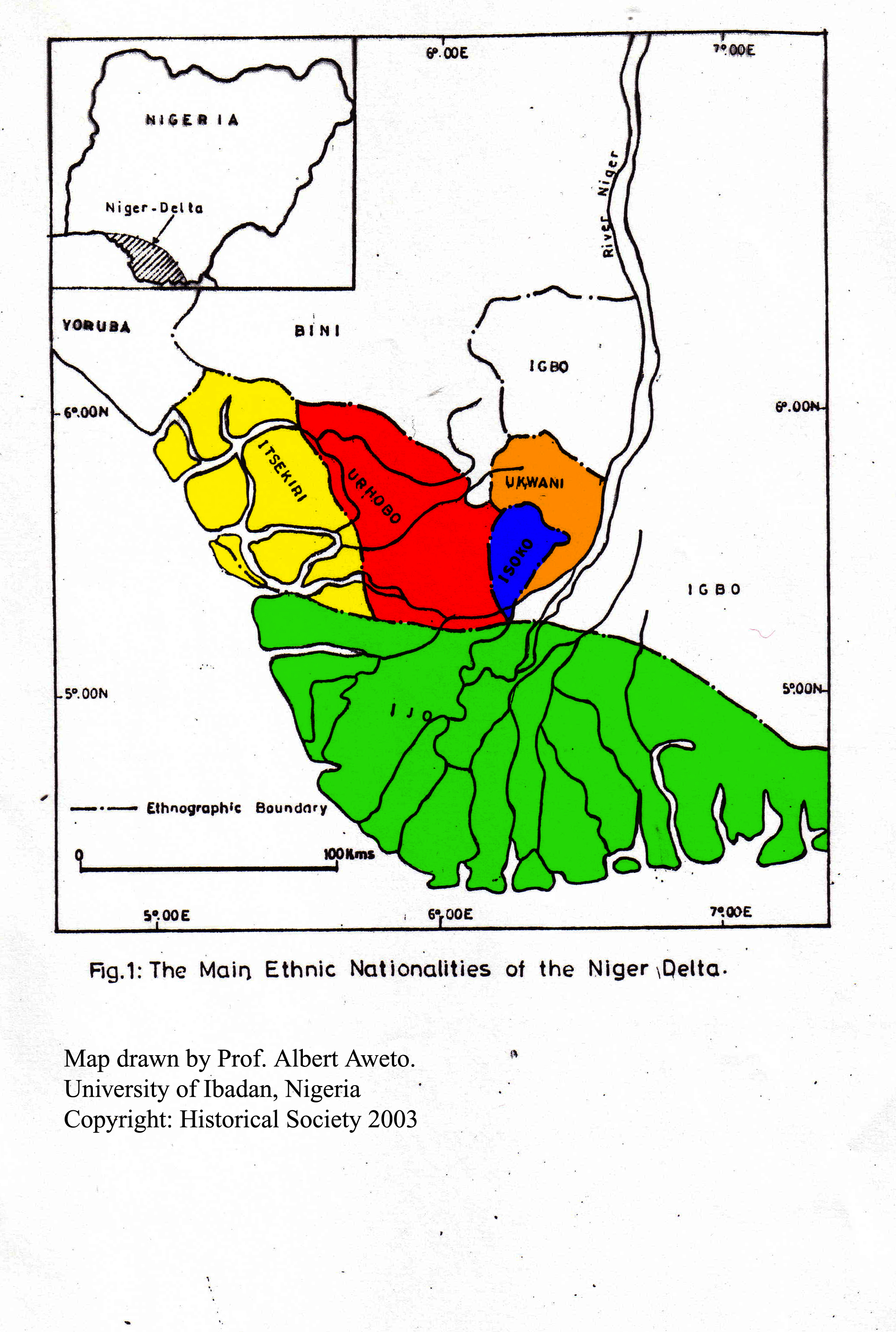
Urhoboland is surrounded by five neighbouring ethnic nationalities in
location and relationships that date back to many centuries. To
Urhoboland's south and to its west are, respectively, the Ijaw and the
Itsekiri who inhabit the swampy lands of the Niger Delta in the Atlantic
coastal areas. To the south east are the Isoko who were regarded and
treated by the British as the same people as the Urhobo. To Urhoboland's
northwest are the Benin whose empire was once great but had shrunk
considerably by the the first half of the 1890s, even though its remnant
was the cause of much concern to British imperial ambitions in the report
under discussion. Finally, to Urhoboland's northeast are the Ukwuani,
reputed to be among the earliest indigenous people to settle in the Niger
Delta.
By 1895, British imperial agents had made contacts with most of these
people. Indeed, the Atlantic ethnic nationalities of the Ijaw and the
Itsekiri had trading experiences with the English, as with other European
trading nations, dating back to several centuries. The British had similar
experiences with the Benin whose king had exercised enormous power and
influence in many areas of the western Niger Delta. Then in the later half
of the 1880s, the British Royal Niger Company established contacts with
Urhobos in their waterways. The Urhobo and Isoko fell to British
colonialism, beginning with a series of
"Treaties of Protection,"
from 1891 to 1894. However, up to the first half of the 1890s, the Ukwuani
were largely untouched by this flurry of British imperial expansion in the
western Niger Delta.
The report reproduced in the following pages is of historical interest for
several reasons, beyond the fact that the Ukwuani were the last of the
ethnic nationalities to be brought under British colonial rule in the
western Niger Delta. First, the mission of the expedition was stated by
Sir Roger Moor, in his detailed
letter dispatching the report to the Foreign Office, as follows:
This journey was undertaken . . . with a view to opening up friendly
communications with the natives and assist in settling difficulties
among them which were damaging to trade. It was also anticipated
that the source of the Jamiesen River [a tributary of Ethiope River]
might be discovered.
First, it should be clear from this statement that trade was of paramount
interest to British expansion in the 1890s. The Ukwuani region had not
been directly engaged in trade with the British up until then.
Second, it is remarkable from this report that plotting the geography of
these areas was a principal method of British imperial conquest in
the western Niger Delta.
In the body of the report by Hugh Leeky, two
issues dominate the events of the the expedition. First, there is the
persistent complaint of the seizure of persons and goods in the trading of
the area, "preventing Sobos [Urhobo] and Kwalis [Ukwuani] from trading
with each other." This was a pernicious practice that grew from the
breakdown of interethnic relations in the nineteenth century that surfaced
elsewhere in the Niger Delta (thus see
here). The second problem that loomed over British ambitions in this area was
the rival imperial presence of Benin. Although the British had
seriously undermined Benin imperial influences in much of the western
Niger Delta, Ukwuani remained under Benin domination well until the
British war against the Benin in 1897, a year after the British journey
into Ukwuani country.
It is also noteworthy that Urhobo and Ukwuani contacts were extensive
before the British arrived in Ukwuani country. Cultural, especially
marriage, ties between Urhobos and Ukwuani apparently date back to a long
time before British colonialism in the 1890s. It is noteworthy that the
journey to Ukwuani country went through Urhobo towns of Sapele, Okpara,
Eku, and, "Ajulumi." Apparently, close cultural ties between Urhobo and
Ukwuani helped the British imperial agents in their mission of negotiating
with the Ukwuani.
Finally, the British corruption of Urhobo and Ukwuani names is remarkable.
The Urhobo were called "Sobo" -- a corruption that dates back to the
arrival of the Portuguese in the middle 1480s. The British could not
handle the Ukwuani name, calling them Kwale instead. The "Kwale"
corruption stuck throughout colonial times, although it has largely been
erased in the postcolonial era.
Peter P. Ekeh
Editor@waado.org
State University of New York at Buffalo